
Prof. Dr. Thorsten Jungmann (last updated 2026-10-03)
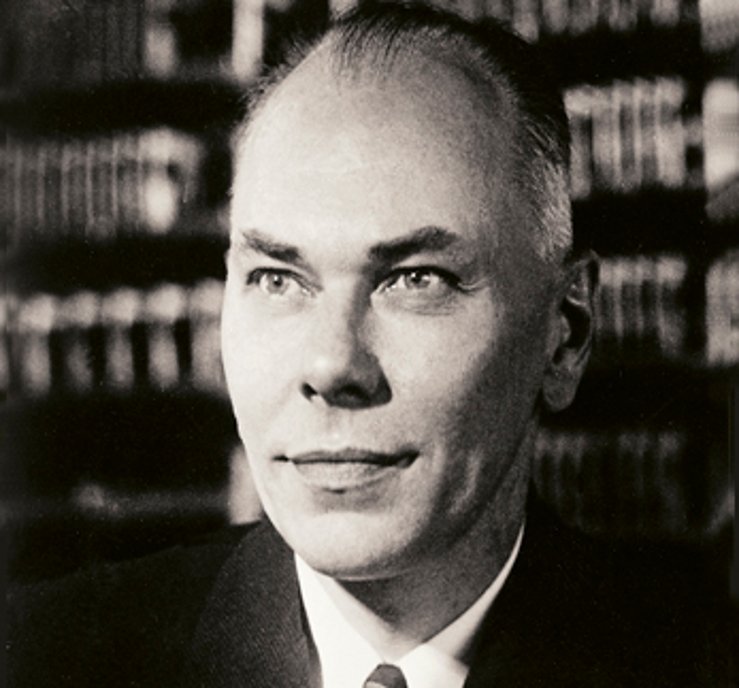
Howard Hathaway Aiken (1900–1973) was an American physicist and a pioneer in computing. He was born in Hoboken, New Jersey, grew up in Indianapolis and received his B.S. in electrical engineering from the University of Wisconsin–Madison in 1923. At Harvard University he received his M.A. in 1937 and his Ph.D. in 1939, both in physics. While working on space-charge conduction in vacuum tubes he encountered differential equations that he could only solve numerically. He envisioned an electromechanical computing device that could do much of the tedious work for him and in his proposal referred to the Analytical Engine of Charles Babbage.
This device was originally called the Automatic Sequence Controlled Calculator (ASCC) and was later renamed Harvard Mark I. Aiken was the original conceptual designer behind IBM’s Harvard Mark I, one of the earliest large-scale automatic digital computers. With engineering, construction and funding from IBM, the machine was completed in 1943 and installed at Harvard in February 1944; it was built from switches, relays, rotating shafts and clutches. One of the first programs to run on it was started on 29 March 1944 by von Neumann. In 1947 Aiken completed the Harvard Mark II. The Mark III used some electronic components, and the Mark IV was all-electronic. Also in 1947 he introduced a master’s programme in computer science at Harvard, one of the earliest graduate programmes of its kind. In 1970 he received the IEEE Edison Medal.
The Aiken code (German: Aiken-Code), also known as 2421 code, is named after him. It is a complementary binary-coded decimal (BCD) code in which a group of four bits is assigned to each decimal digit from 0 to 9. In contrast to the standard 8421 BCD code, the most significant bit has the weight 2 instead of 8, which gives the weights 2-4-2-1. The digits 0 to 4 are mirror-image complementary to the digits 5 to 9. Because the code is self-complementing, the nines’ complement of a digit is obtained by inverting all four bits.
Reference and further reading:
https://en.wikipedia.org/wiki/Howard_H._Aiken
https://en.wikipedia.org/wiki/Aiken_code
https://en.wikipedia.org/wiki/Harvard_Mark_I
Image source: Wikimedia Commons (public domain, author not stated)
