a) Describe the characteristics of analogue and digital signals, and name the differences between them.
b) Give three examples each of analogue and of digital signals, both from your private everyday life and from industry – twelve examples in all.
c) Explain in your own words what an analogue-to-digital (A/D) converter does in the signal chain from a sensor to an actuator, for example in the smartphone.
d) Explain in your own words what a digital-to-analogue (D/A) converter does in this signal chain.
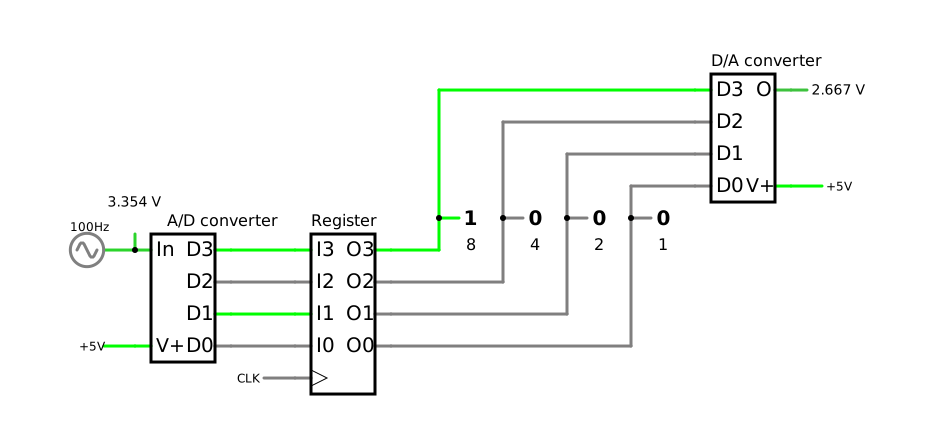
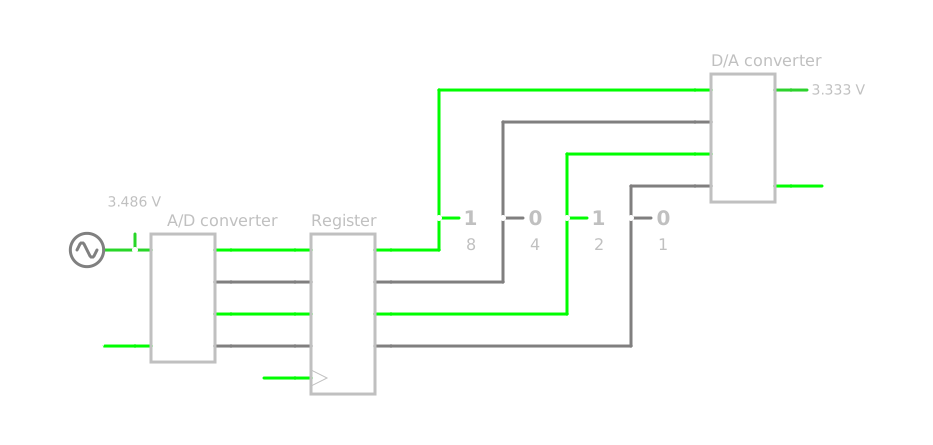
e) The simulation below converts a sinusoidal voltage of 100 Hz between 0 and 5 V into numbers with an A/D converter of 4 bits and turns them back into a voltage with a D/A converter of 4 bits. Each time the clock CLK of 2 kHz switches from 0 to 1, the register loads the number from the A/D converter and holds it until the next time; the four bits of this number appear above the weights 8, 4, 2 and 1. Open the simulation and compare the input voltage with the output voltage on the oscilloscope. Describe the difference, and explain where the steps of the output voltage come from. Think about how many different numbers 4 bits can represent and about what the register does.
f) Open the settings of the clock CLK in the simulation with a double-click and reduce its frequency, first to 500 Hz and then to 150 Hz. Describe what you observe on the oscilloscope. What follows for how often a converter has to take a number from its input?
Solution
a) Analogue: changes continuously and can take any value in its range; maps the information directly; every disturbance becomes part of the information. Digital: carries the information in encoded form; takes only discrete values, 0 and 1, each in its own voltage range; noise immunity: small disturbances change nothing; after A/D conversion, a sequence of numbers taken at regular intervals
b) Private, analogue: voltage of the microphone, of the loudspeaker, of the rechargeable battery. Private, digital: power button, data on the cable to a laptop, signals between processor and memory. Industry, analogue: temperature sensor, pressure sensor, voltage that sets the rotational frequency of a fan. Industry, digital: light barrier at a programmable logic controller, limit switch, switching signal of a relay
c) It turns the analogue voltage of the sensor into a number that the microcontroller can process; smartphone: the voltage of the microphone becomes numbers for the processor
d) It turns a number back into a voltage that drives an actuator; smartphone: the numbers become a voltage for the loudspeaker
e) The output follows the input as a staircase. Steps in height: 4 bits give only 16 numbers and thus only 16 output voltages, in the simulator 1/3 V apart. Steps in time: the register loads a new number only every 0.5 ms and holds it in between
f) 500 Hz: coarser steps, the output still rises and falls with the input of 100 Hz. 150 Hz: the output changes only every 6.7 ms and oscillates with about 50 Hz. A converter has to take numbers often enough, several times per period of the signal