
Prof. Dr. Thorsten Jungmann (last updated 2025-10-27)
Relates to EE1-03 Sources
Task
A D cell has the open-circuit voltage and the short-circuit current . Which terminal voltage results when the current is drawn from it?
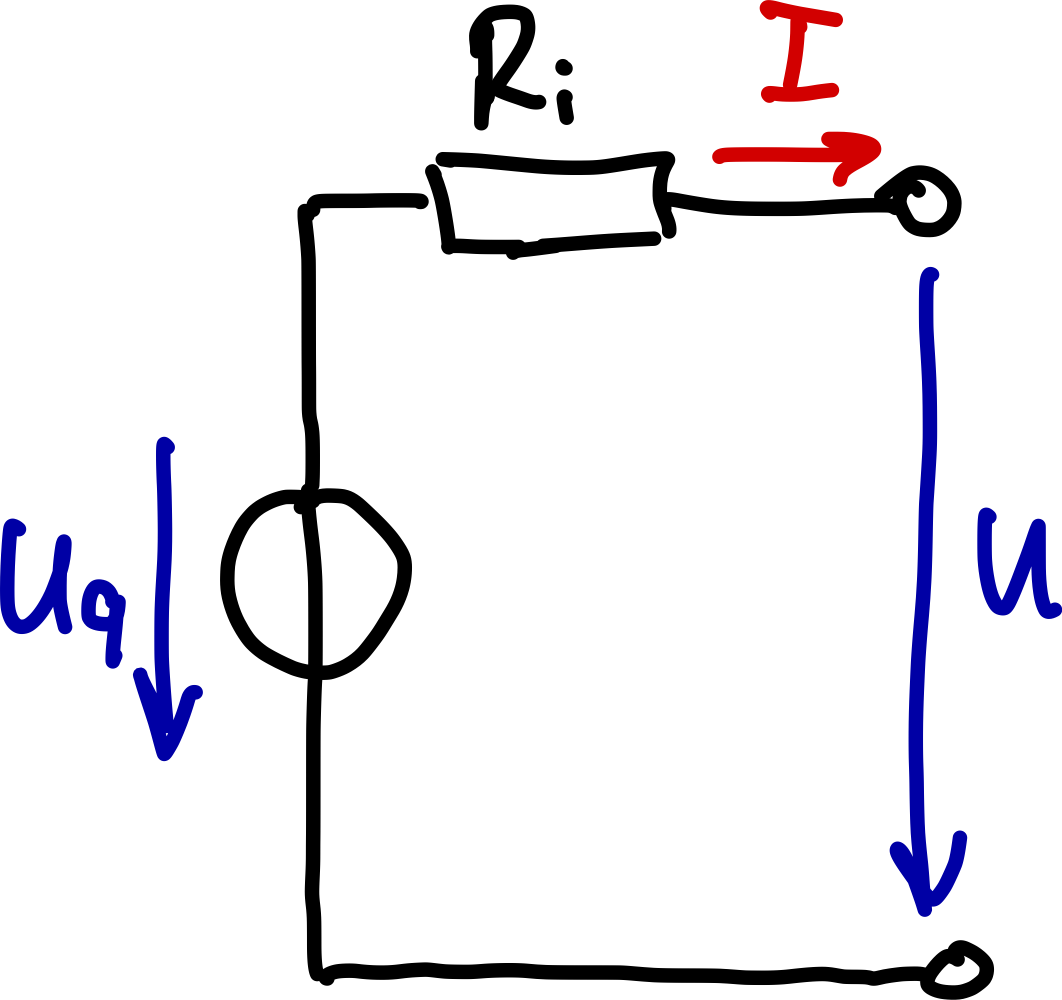
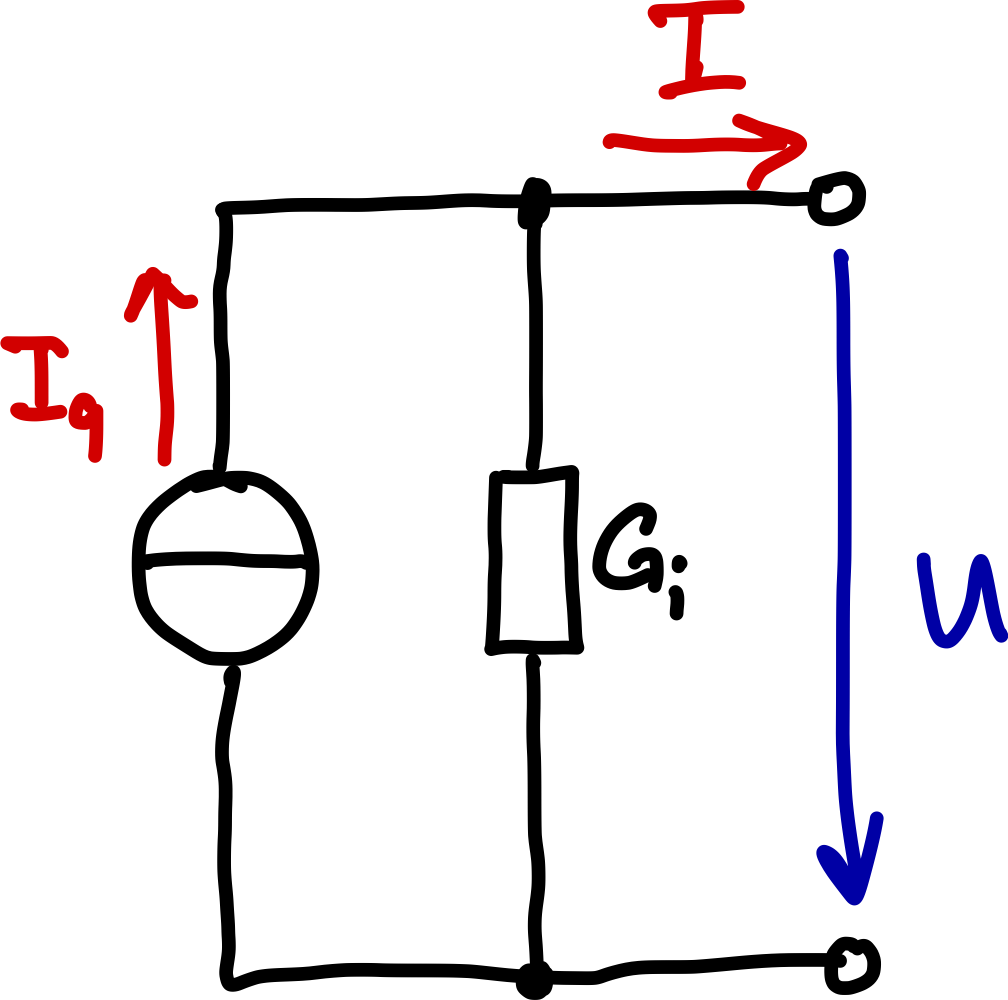
a) Sketch the equivalent circuits for the linear voltage source and the linear current source.
b) Calculate the elements of the equivalent circuits.
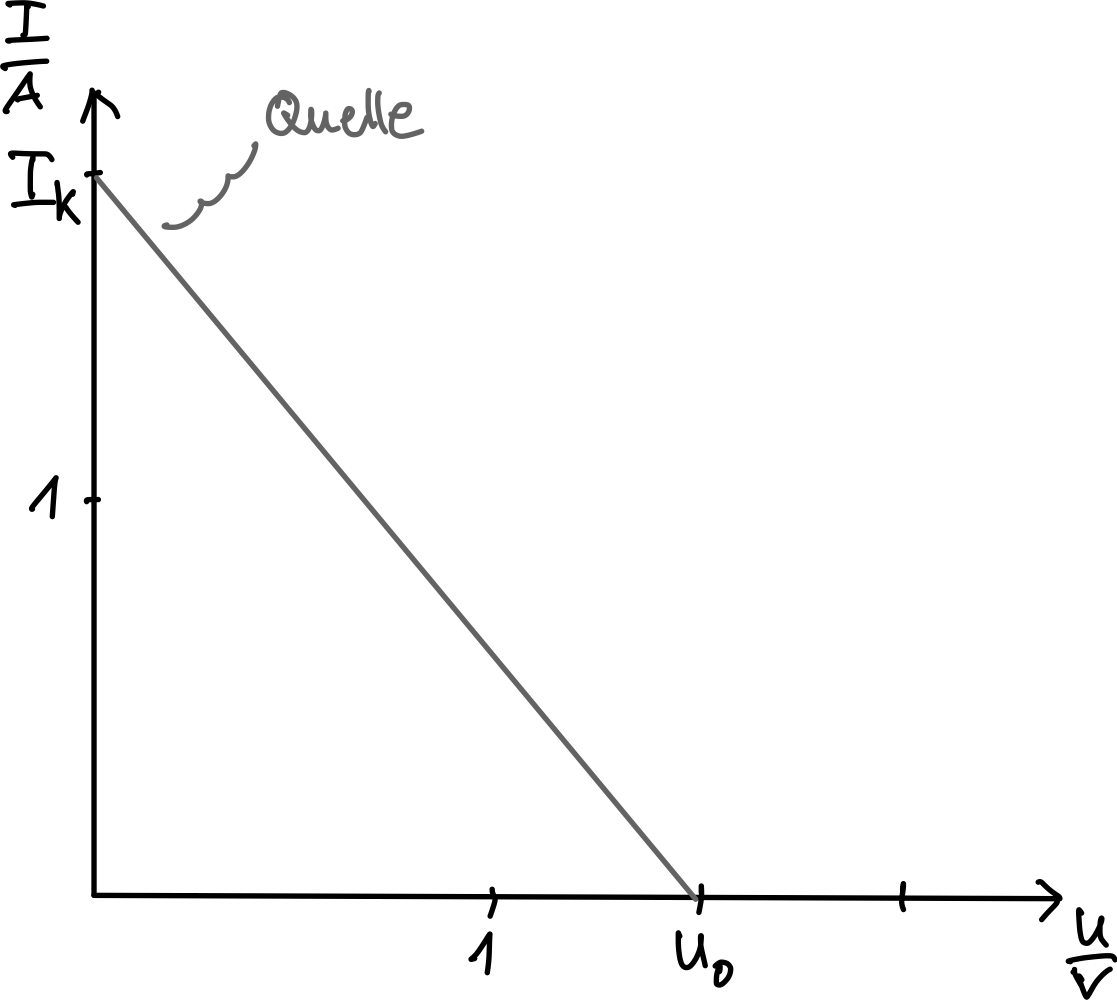
c) Draw the I-U characteristic curve of the linear source.
d) Determine the terminal voltage by calculation as specified in the task.
e) Determine the terminal voltage graphically as specified in the task and compare the result with the result of the calculation in d).
Solution
a) Sketches
b) /
c) Characteristic curve
d)
e) approximately agrees
Solution
Given
Given explicitly:
- Open-circuit voltage:
- Short-circuit current:
- Current drawn:
Known:
- Internal resistance (linear):
- Thevenin/Norton equivalence: voltage source in series with current source in parallel with
- Characteristic curve:
Required
a) Sketches of the equivalent circuits (Thevenin/Norton)
b) Elements of the equivalent circuits
c) I-U characteristic curve of the source
d) Terminal voltage by calculation for
e) graphically and comparison with d)
a) Equivalent circuits
Thevenin (linear voltage source): in series with
Norton (linear current source): in parallel with
b) Calculating the elements
Internal resistance:
Internal conductance:
c) I-U characteristic curve
Equation of the straight line (voltage form):
Reference points: and .
d) Terminal voltage by calculation
For :
(Check: is of ⇒ voltage drop of .)
e) Terminal voltage graphically and comparison
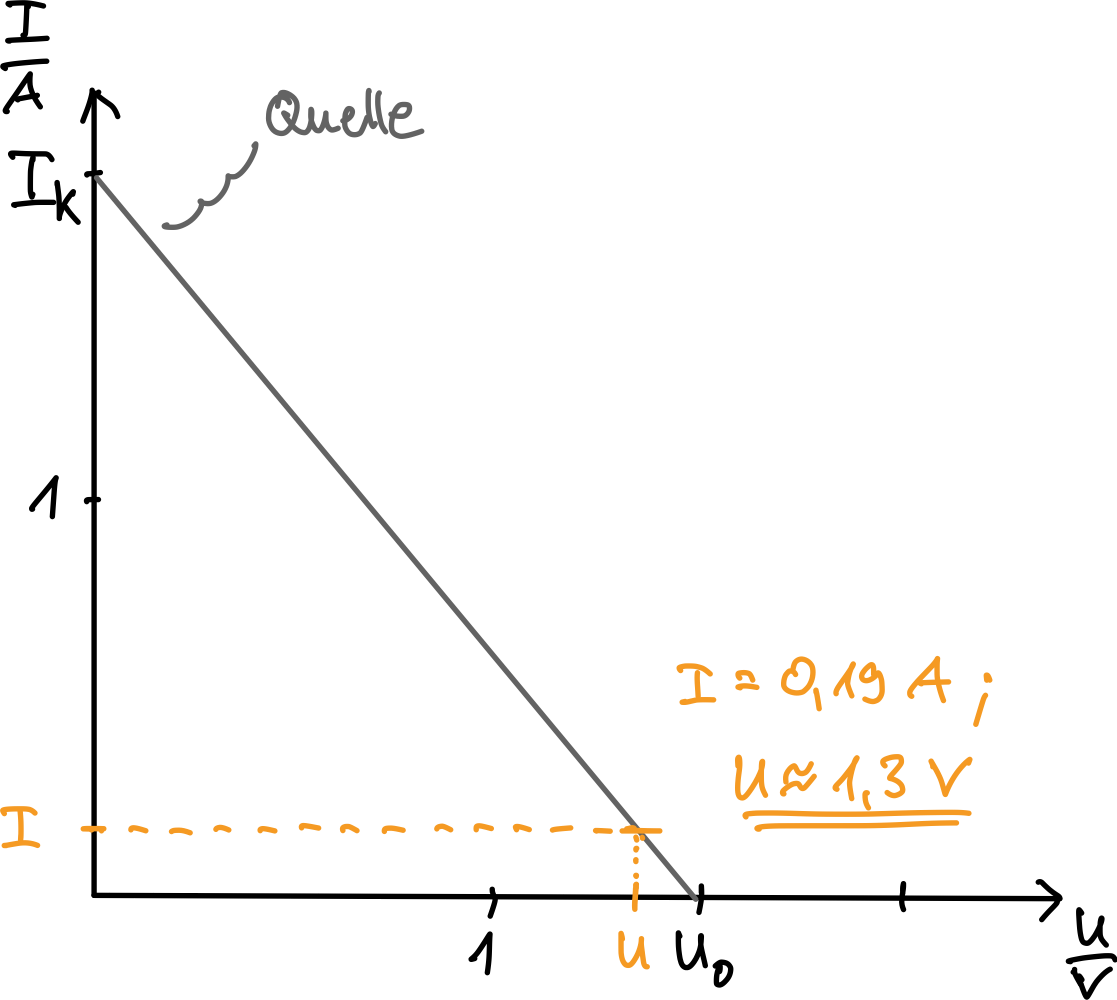
Read off from the straight line at :
Comparison: approximately agrees with d) (inaccuracy of the graphical reading)