
Prof. Dr. Thorsten Jungmann (last updated 2025-08-28)
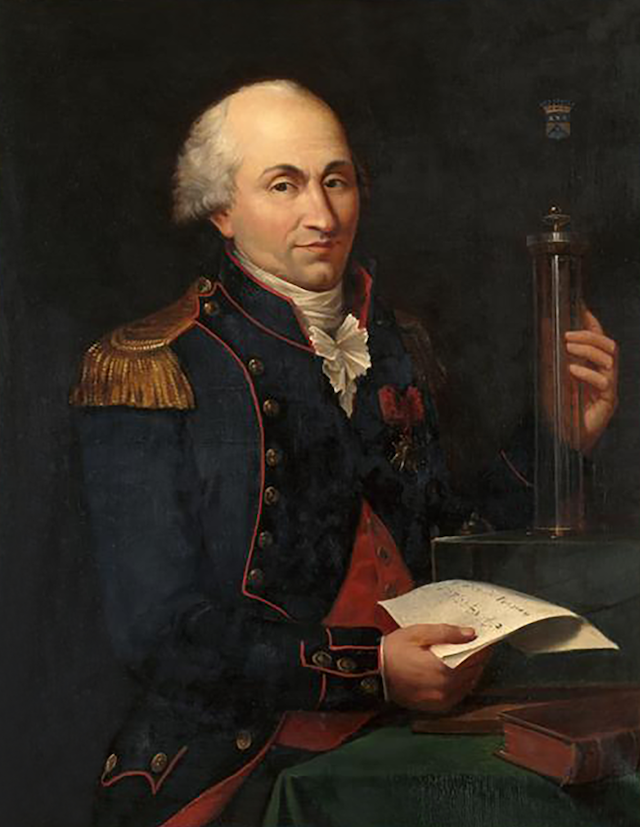
Charles-Augustin de Coulomb (1736–1806) was a French physicist and engineer who is regarded as the founder of electrostatics and magnetostatics. He became famous for Coulomb’s law, which is named after him and describes the forces between electric charges. Coulomb was the first to show quantitatively that two point charges attract or repel each other the more strongly, the greater their electric charge is, and that this force decreases with the square of the distance between the charges – very similar to Newton’s law of gravitation.
For his experiments, Coulomb developed the so-called torsion balance, with which he could reliably measure even very small forces. This invention was crucial for testing the natural laws of electricity and magnetism experimentally. In addition to his groundbreaking work on electricity, he also made important contributions to mechanics, in particular to the understanding of friction forces. For his achievements, he became a member of the French Academy of Sciences.
In honour of Coulomb, the international SI unit of electric charge bears the name coulomb (C). One coulomb is the amount of electric charge that flows through a conductor in one second at a current of one ampere. The coulomb is thus a central quantity in electrical engineering and physics.
Coulomb’s research created a fundamental understanding of the forces between electric charges, which to this day forms the basis for numerous applications in the fields of electrical engineering, physics and technology.
Reference and further reading:
https://en.wikipedia.org/wiki/Charles-Augustin_de_Coulomb
Image source: Wikipedia