
Prof. Dr. Thorsten Jungmann (last updated 2026-10-03)
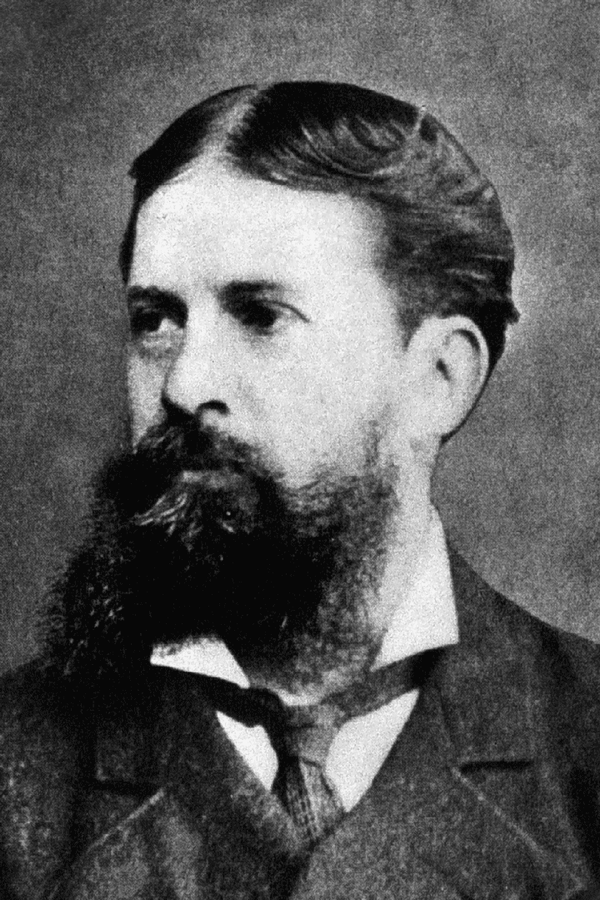
Charles Sanders Peirce (1839–1914) was an American scientist, mathematician, logician and philosopher who is sometimes known as ‘the father of pragmatism’. He was born in Cambridge, Massachusetts, as the son of Benjamin Peirce, a professor of mathematics and astronomy at Harvard University. Educated as a chemist, he was employed as a scientist for thirty years: between 1859 and 1891 he worked intermittently for the United States Coast Survey, mainly in geodesy and gravimetry. His non-tenured position as a lecturer in logic at Johns Hopkins University, to which he was appointed in 1879, was the only academic appointment he ever held.
Peirce made major contributions to logic, such as theories of relations and quantification. On the first of five trips to Europe for the Survey, in 1870–1871, he sought out De Morgan, William Stanley Jevons and William Kingdon Clifford, British mathematicians and logicians whose turn of mind resembled his own.
Two of his insights matter for digital electronics. In 1880–81 he showed how Boolean algebra could be done via a repeated sufficient single binary operation, the logical NOR, anticipating Sheffer by 33 years; the relevant paper, however, was not published until 1933. The operator for NOR is also called the Peirce arrow (German: Peirce-Pfeil). In 1886 Peirce saw that Boolean calculations could be carried out via electrical switches, anticipating Shannon by more than 50 years.
Reference and further reading:
https://en.wikipedia.org/wiki/Charles_Sanders_Peirce
https://en.wikipedia.org/wiki/Henry_M._Sheffer
https://en.wikipedia.org/wiki/Logical_NOR
Image source: Wikimedia Commons (public domain, NOAA Office of NOAA Corps Operations)
