
Prof. Dr. Thorsten Jungmann (last updated 2026-10-03)
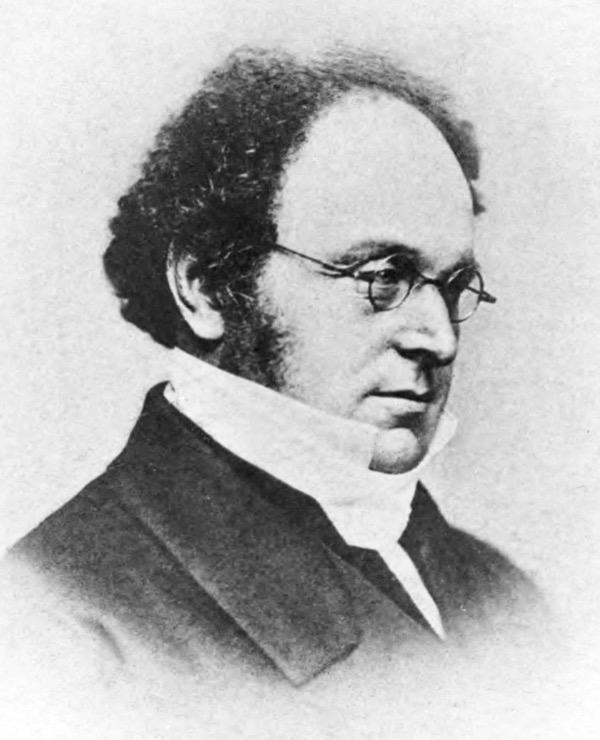
Augustus De Morgan (1806–1871) was a British mathematician and logician. He was born in Madurai, India, and his family moved to England when he was seven months old. In 1823 he enrolled at Trinity College, Cambridge. In 1828, at the age of twenty-one, he was appointed Professor of Mathematics at London University (now University College London); he resigned in 1831, returned in 1836 and resigned again in 1866. Most of his mathematical writing consists of textbooks, and he is also known for coining the term ‘mathematical induction’.
His best-known contribution to logic is the set of laws that bear his name. De Morgan’s laws (German: de-morgansche Gesetze) are a pair of transformation rules of propositional logic and Boolean algebra: the negation of ‘A and B’ is the same as ‘not A or not B’, and the negation of ‘A or B’ is the same as ‘not A and not B’. They allow conjunctions and disjunctions to be expressed purely in terms of each other via negation, and they are applied to simplify logic expressions in computer programs and in digital circuit designs. De Morgan stated the laws in his book ‘Formal Logic’ (1847). Similar rules were known to medieval logicians such as William of Ockham; De Morgan is credited with stating the laws in the terms of modern formal logic.
‘Formal Logic’ appeared in 1847 at almost the same time as Boole’s pamphlet ‘The Mathematical Analysis of Logic’. De Morgan had corresponded with Boole since 1842 and advocated his work.
Reference and further reading:
https://en.wikipedia.org/wiki/Augustus_De_Morgan
https://en.wikipedia.org/wiki/De_Morgan%27s_laws
Image source: Wikimedia Commons (public domain, Sophia Elizabeth De Morgan)
