
Prof. Dr. Thorsten Jungmann (last updated 2026-10-03)
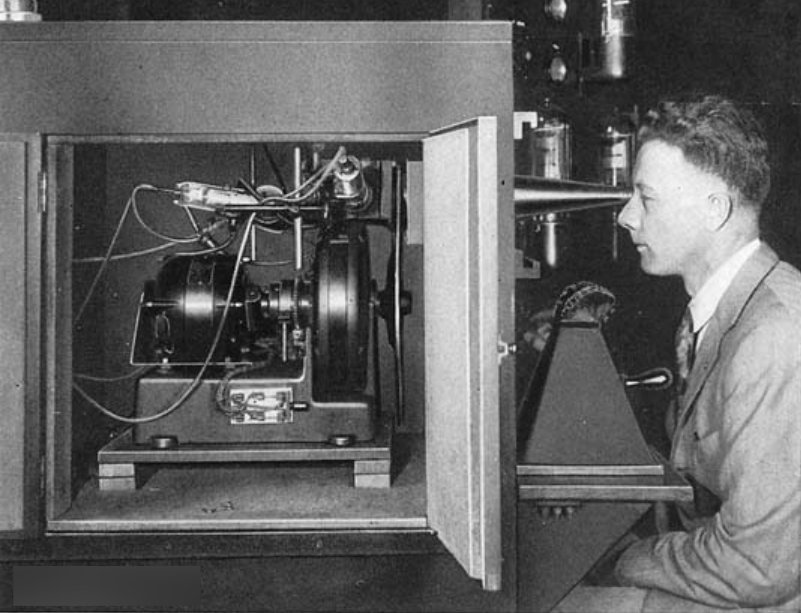
Frank Gray (1887–1969) was a physicist and researcher at Bell Labs who made numerous innovations in television, both mechanical and electronic. He graduated in physics from Purdue University in 1911. At Bell Labs he conducted pioneering research on the development of television: in 1927 he proposed an early form of the flying-spot scanner, and in 1930 he helped to develop a two-way mechanically scanned television system. In 1934 he wrote, together with Pierre Mertz, the classic paper on the mathematics of raster scan systems.
Gray also took part in the early days of the digital revolution at Bell Labs. He provided the binary code used by Raymond W. Sears in his ‘PCM tube’, a beam deflection tube that was used in William M. Goodall’s ‘Television by pulse code modulation’. In his patent application of 1947, which was granted in 1953 as ‘Pulse Code Communication’, he introduced the term reflected binary code and remarked that the code had ‘as yet no recognized name’. He derived the name from the fact that the code ‘may be built up from the conventional binary code by a sort of reflection process’.
The Gray code (German: Gray-Code), also called reflected binary code, is an ordering of the binary numeral system in which two successive values differ in only one bit. This matters for devices that indicate a position with switches: physical switches do not change state exactly in synchrony, so with the natural binary code a transition such as from 3 to 4 can briefly read a spurious position, whereas with a Gray code only one switch changes at a time. The principle is older: Louis Gros (1872) and Baudot (1870s) used it, and Stibitz described such a code in a patent application of 1941; it was later named after Gray by others who used it. Since 1953 Gray codes have also been used to label the axes of Karnaugh maps.
Reference and further reading:
https://en.wikipedia.org/wiki/Frank_Gray_(researcher)
https://en.wikipedia.org/wiki/Gray_code
Image source: Wikimedia Commons (public domain, Bell Labs/AT&T)
