
Prof. Dr. Thorsten Jungmann (last updated 2026-10-03)
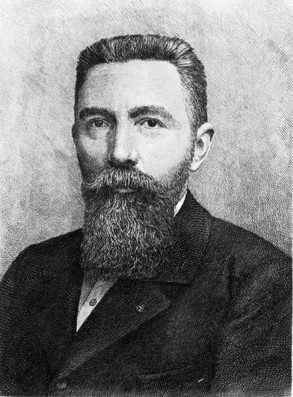
Jean-Maurice-Émile Baudot (1845–1903) was a French telegraph engineer and inventor of the Baudot code, an early five-unit digital code for telegraphy. He was born in Magneux, Haute-Marne, the son of a farmer. His only formal education was at the local primary school; in 1869 he joined the French Post & Telegraph Administration as an apprentice operator. The telegraph service trained him in the Morse telegraph and sent him on a four-month course on the Hughes printing telegraph, which later inspired his own system.
Baudot devised one of the first applications of time-division multiplexing in telegraphy: with synchronized clockwork-powered switches at the transmitting and receiving ends, several messages could be sent over a single line. On 17 June 1874 he patented his printing telegraph, whose keyboard had five piano-type keys. His inventions combined the printing mechanism of the Hughes instrument, a distributor invented by Bernard Meyer in 1871 and the five-unit code devised by Gauss and Wilhelm Weber with original ideas of his own. The French Telegraph Administration tested the system from 1875, successfully in 1877, and it won him the gold medal of the Paris Exposition Universelle in 1878. Baudot received little help from the administration and often had to fund his own research.
The Baudot code (German: Baudot-Code) is a 5-bit code with equal on and off intervals that allowed the telegraph transmission of the Roman alphabet, punctuation and control signals. It was later standardized as International Telegraph Alphabet No. 1 (ITA1) and was modified by Donald Murray in 1901. The Baudot code was the predecessor of the International Telegraph Alphabet No. 2 (ITA2), the most common teleprinter code in use before ASCII. Baudot ordered the alphabetic characters on his print wheel using a reflected binary code, so the 5-bit code has been recognized as a reflected binary code, like the Gray code. The baud (symbol Bd; German: Baud) is named after him: in 1926 it was designated as the unit of telegraph transmission speed. Today it is the unit of the symbol rate, the number of symbol changes (signalling events) per second; with exactly two symbols, typically 0 and 1, the baud rate and the bit rate in bit/s are equal.
Reference and further reading:
https://en.wikipedia.org/wiki/Émile_Baudot
https://en.wikipedia.org/wiki/Baudot_code
https://en.wikipedia.org/wiki/Baud
https://en.wikipedia.org/wiki/Gray_code
Image source: Wikimedia Commons (public domain, engraving by A. Delzers, published by the International Telecommunication Union)
