
Prof. Dr. Thorsten Jungmann (last updated 2025-08-28)
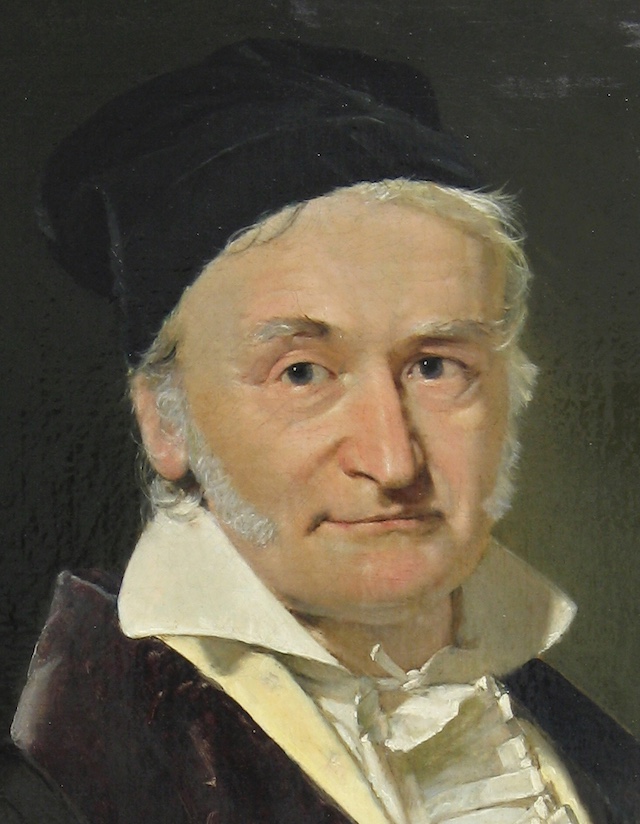
Carl Friedrich Gauss (1777–1855) is one of the most outstanding mathematicians and natural scientists of all time and is often called the ‘Prince of Mathematics’. His wide-ranging body of work shaped numerous disciplines – from mathematics and astronomy to physics and electrical engineering. In the field of electrical engineering and physics, Gauss made significant contributions, in particular with his studies on electricity and magnetism. Together with Wilhelm Weber, he developed the world’s first electromagnetic telegraph in 1833, which is regarded as a milestone for communications engineering. In addition, he designed instruments such as the magnetometer, with which the strength of the Earth’s magnetic field could be measured exactly.
A further fundamental discovery is ‘Gauss’s law’ (or Gauss’s theorem), which is named after him; it describes the electric flux through a closed surface and is of central importance in electrostatics and electrodynamics. The gauss (G or Gs) is still in use today in the obsolete centimetre–gram–second system (CGS system) as the unit name for the magnetic flux density.
In mathematics, Gauss shaped, among other things, the method of least squares (important for curve fitting and error analysis) and developed the so-called ‘Gauss method’, formally also known as Gaussian elimination. This is a fundamental algorithm for solving systems of linear equations. The method is used, among other things, to solve the systems of equations in the analysis of electrical networks, which are set up with the help of Kirchhoff’s laws. The Gauss method consists in simplifying the system of equations step by step through targeted equivalent transformations (addition, subtraction, multiplication and interchanging of equations) so that each equation contains one unknown fewer than the previous one. In the end, you arrive at a so-called echelon form, in which the unknowns can be calculated successively ‘backwards’ from bottom to top (‘back substitution’). This strategy allows a systematic and efficient solution of systems of linear equations of any size.
Gauss’s interdisciplinary research and inventions still form a central foundation for electrical engineering, physics and numerous technical applications today.
Reference and further reading:
https://en.wikipedia.org/wiki/Carl_Friedrich_Gauss
Image source: Wikipedia