
Prof. Dr. Thorsten Jungmann (last updated 2025-08-28)
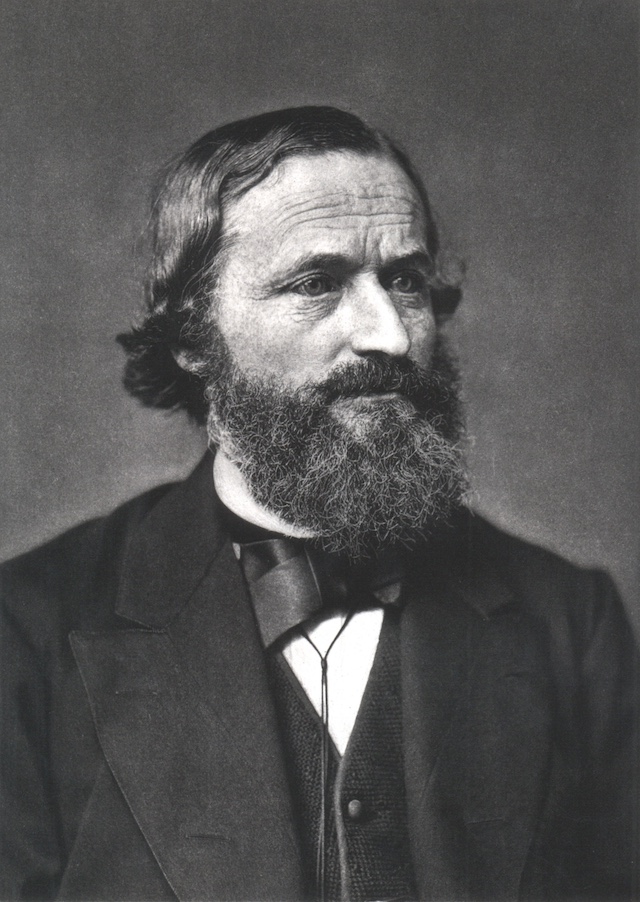
Gustav Robert Kirchhoff (1824–1887) was an influential German physicist who made fundamental contributions to electrical engineering, physics and chemistry. He became particularly well known for the ‘Kirchhoff’s laws’ named after him, which to this day are of central importance for analysing and understanding electric circuits. Kirchhoff’s scientific curiosity and his mathematical precision make him a central figure in science and engineering teaching to this day.
Even as a young student in Königsberg, Kirchhoff formulated these two fundamental laws, known as Kirchhoff’s laws:
- The first law – Kirchhoff’s current law (German: Knotenpunktsatz or Stromgesetz) – states that at every junction (node) of an electric circuit the sum of the currents flowing in is equal to the sum of the currents flowing out. It follows that in an ideal electric circuit no current ‘disappears’; instead, the current is distributed according to the structure of the network.
- The second law – Kirchhoff’s voltage law (German: Maschensatz or Spannungsgesetz) – states that in every closed loop of an electrical network the sum of all voltages is equal to zero. Physically, this means that all the energy absorbed in the circuit is also released again.
These two laws make it possible to calculate and understand even complex electric circuits and networks systematically – they form the mathematical foundation of network analysis in electrical engineering.
In addition to his work on the theory of electricity, Kirchhoff was also a co-founder of spectral analysis: together with Robert Bunsen, he discovered the chemical elements caesium and rubidium in this way. Moreover, with ‘Kirchhoff’s law of thermal radiation’ he decisively helped to shape the foundations of thermodynamics and thus the development of quantum physics.
Reference and further reading
https://en.wikipedia.org/wiki/Gustav_Kirchhoff
Image source: Wikipedia