
Prof. Dr. Thorsten Jungmann (last updated 2026-10-04)
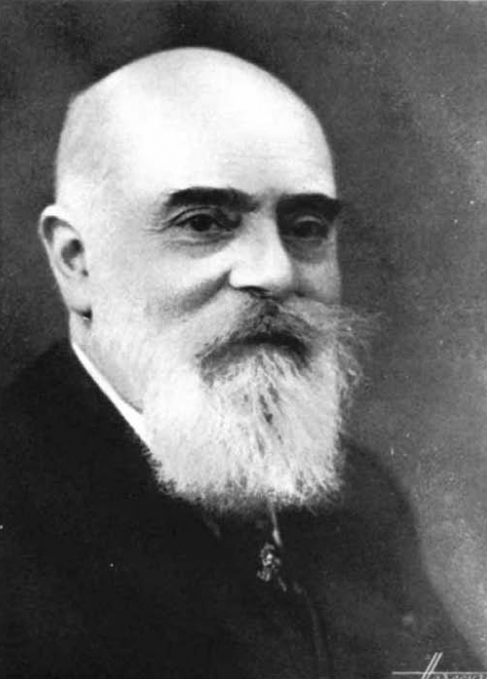
Henri Azariah Abraham (1868–1943) was a French physicist who made important contributions to the science of radio waves. He was born on 12 July 1868 in Paris, studied at the École normale supérieure from 1886 to 1889 and received his doctorate in physical sciences in 1892. He became a lecturer at the École normale supérieure and director of its physics laboratory, and in 1912 professor of physics at the Faculty of Paris. He retired in 1937. In 1943 he was arrested in Aix-en-Provence and deported to the Auschwitz concentration camp, which he reached on 20 December 1943; he was probably murdered on arrival. The Three Physicists Prize is named in memory of him, Bloch and Georges Bruhat, who all died in deportation in Nazi camps.
Before the First World War Abraham measured the propagation speed of radio waves from their propagation times between remote stations, finally between Paris and Washington (1913–14). Mobilized in 1914 in the Department of Military Telegraphy, he took part, together with Bloch, in the development of the TM triode, an amplifying vacuum tube for radio reception. The two also invented the astable multivibrator, known as the Abraham–Bloch multivibrator (German: astabile Kippstufe nach Abraham und Bloch): two vacuum tube amplifiers cross-coupled by a resistor–capacitor network. The circuit produced a square wave, in contrast to the sine wave of most other oscillator circuits of the time, so its output contained many harmonics above the fundamental frequency. For this reason Abraham and Bloch called it a multivibrateur. The harmonics allowed radio frequencies to be measured with unprecedented accuracy, and the military used the method during the First World War. Abraham and Bloch described the circuit in Publication 27 of the French Ministère de la Guerre and in Annales de Physique in 1919.
A multivibrator is a circuit that implements simple two-state devices such as relaxation oscillators, timers, latches and flip-flops. There are three types. The astable multivibrator continually switches from one state to the other. The monostable multivibrator (German: monostabile Kippstufe) has one stable state; after a trigger pulse it enters the unstable state and returns to the stable state after a set time. The bistable multivibrator (German: bistabile Kippstufe) is stable in either state and is also known as a flip-flop or latch.
Reference and further reading:
https://en.wikipedia.org/wiki/Henri_Abraham
https://en.wikipedia.org/wiki/Multivibrator
Image source: Wikimedia Commons (public domain, Studio Harcourt)
