
Prof. Dr. Thorsten Jungmann (last updated 2026-10-25)
Relates to DET-04 Algorithmic minimization of functions with many inputs and hazard analysis
Task
In a Karnaugh map, each loop of ones that cannot be enlarged is a prime implicant of the function. In each function, the first variable has the highest weight.
a) Draw the Karnaugh map of , and give all its prime implicants. Which of its ones does only a single prime implicant cover? Which prime implicants are essential, and which are redundant? Give the minimal disjunctive normal form (DNF).
b) Answer the same questions for .
c) Draw the Karnaugh map of , and give all its prime implicants and the essential ones among them. Give a minimal DNF. Is it unique?
Solution
Given
Given explicitly:
- a)
- b)
- c)
- in each function, the first variable has the highest weight
Known:
- Arrangement of the Karnaugh map: neighbouring cells differ in exactly one input, also across the edges (DET-03)
- Loops of ones and the product term of a loop (DET-03)
- Implicants and prime implicants: a prime implicant is a loop of ones that cannot be enlarged (DET-04)
- Essential and redundant prime implicants, minimal disjunctive normal form (DNF) (DET-04)
- Prime implicants that complete the minimal DNF when the essential ones leave ones uncovered (DET-04)
Required
a) and b) all prime implicants of and of , the ones that only a single prime implicant covers, the essential and the redundant prime implicants, and the minimal DNF
c) all prime implicants of , the essential ones among them, a minimal DNF and whether it is unique
a) Three inputs
With three inputs, the map has two rows for and four columns for and ; in the upper row, the cells contain the minterms 0, 1, 3 and 2, in the lower row 4, 5, 7 and 6 (DET-02, 2.6). The four ones of lie in the cells of 1 and 3 in the upper row and of 4 and 5 in the lower row (figure).
Each loop of ones that cannot be enlarged is a prime implicant (DET-04, 1.1). No four ones form a block, so there is no loop of four; three loops of two remain:
- the ones of 1 and 3, neighbours in the upper row: is 0 and is 1, while changes, so the loop yields
- the ones of 4 and 5, neighbours in the lower row: is 1 and is 0, while changes:
- the ones of 1 and 5, neighbours in the second column: is 0 and is 1, while changes:
Now look for ones that only a single prime implicant covers (DET-04, 1.2). The one of minterm 3 lies only in , the one of minterm 4 only in ; in the figure, these two cells are shaded. Both prime implicants are therefore essential. Together, they cover all four ones. The ones of , minterms 1 and 5, already lie in them, so is redundant and is drawn with dashed lines:
| Prime implicant | Minterms | Ones that only it covers | Kind |
|---|---|---|---|
| 1, 3 | 3 | essential | |
| 4, 5 | 4 | essential | |
| 1, 5 | – | redundant |
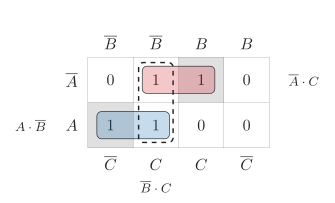
The essential prime implicants form the minimal DNF:
Check with the minterm list: is 1 in rows 1 and 3, in rows 4 and 5; together, these are rows 1, 3, 4 and 5 ✓
b) Four inputs
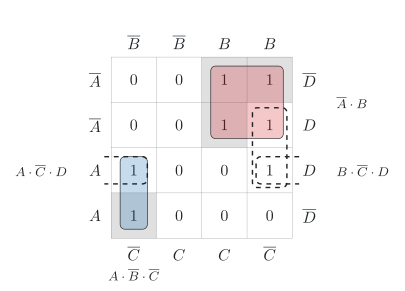
With four inputs, the map has on the left of the rows and on the right of them, above and below the columns. Row by row, the cells contain the minterms 0, 2, 6 and 4; 1, 3, 7 and 5; 9, 11, 15 and 13; 8, 10, 14 and 12 (DET-03, 4.1). The six ones of form three loops that cannot be enlarged (figure):
- the ones of 5, 7, 13 and 15, a square in the third and the fourth column of the two middle rows: and are 1, while and change:
- the ones of 11 and 10 in the second column of the two lower rows: is 1, is 0 and is 1, while changes:
- the ones of 11 and 15 in the third row: , and are 1, while changes:
The ones of minterms 5, 7 and 13 lie only in , the one of minterm 10 only in (shaded cells): both prime implicants are essential. The ones of lie in them as well, minterm 11 in and minterm 15 in , so is redundant (DET-04, 1.2):
| Prime implicant | Minterms | Ones that only it covers | Kind |
|---|---|---|---|
| 5, 7, 13, 15 | 5, 7, 13 | essential | |
| 10, 11 | 10 | essential | |
| 11, 15 | – | redundant |
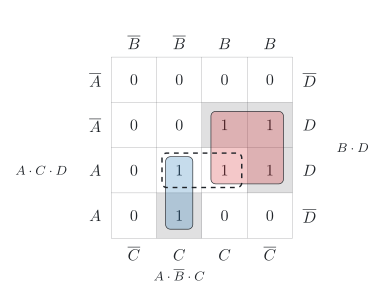
Check with the minterm list: is 1 in rows 5, 7, 13 and 15, in rows 10 and 11; together, these are the six ones of ✓
c) A choice
The seven ones of lie in the cells of 6 and 4 in the first row, 7 and 5 in the second row, 9 and 13 in the third row and 8 in the fourth row (figure). Four loops cannot be enlarged:
- the ones of 4, 5, 6 and 7, a square in the third and the fourth column of the two upper rows: is 0 and is 1, while and change:
- the ones of 9 and 8 in the first column of the two lower rows: is 1, and are 0, while changes:
- the ones of 5 and 13 in the fourth column of the two middle rows: is 1, is 0 and is 1, while changes:
- the ones of 9 and 13 in the third row, neighbours across the left and the right edge: is 1, is 0 and is 1, while changes:
The ones of minterms 4, 6 and 7 lie only in , the one of minterm 8 only in (shaded cells): these two prime implicants are essential. Together, they leave the one of minterm 13 uncovered (DET-04, 1.3). Two prime implicants contain it, and , drawn with dashed lines. Neither of them is essential: each of their ones also lies in another prime implicant. Neither of them is redundant either: minterm 13 lies in no essential prime implicant. In the table, they are therefore of the kind ‘neither’:
| Prime implicant | Minterms | Ones that only it covers | Kind |
|---|---|---|---|
| 4, 5, 6, 7 | 4, 6, 7 | essential | |
| 8, 9 | 8 | essential | |
| 5, 13 | – | neither | |
| 9, 13 | – | neither |
Either of the two completes the minimal DNF, and both forms have three product terms with eight literals:
So the minimal DNF of is not unique: there are two of the same size.
Check with the minterm list: is 1 in rows 4 to 7 and in rows 8 and 9; adds row 13 (and row 5 again), adds row 13 (and row 9 again). Each form is therefore 1 exactly in rows 4, 5, 6, 7, 8, 9 and 13 ✓